
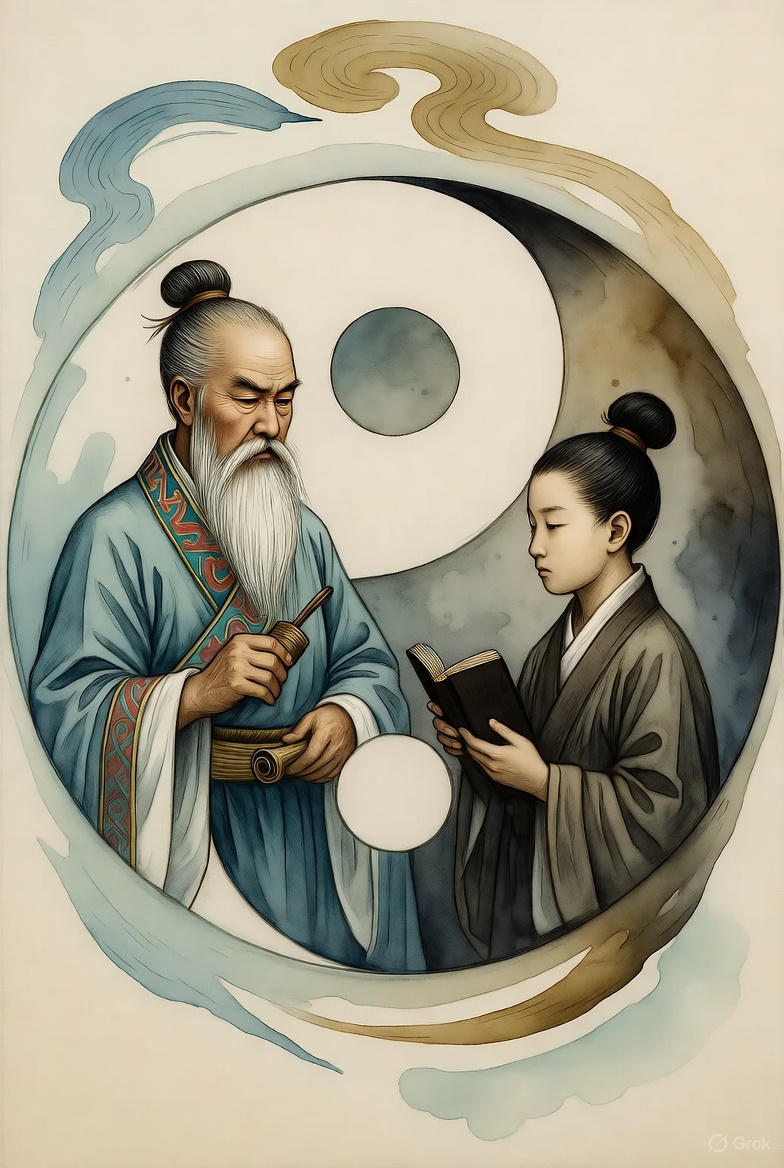
In the dance of knowledge, who truly gains more—the one who receives or the one who gives? From a Taoist lens, this question dissolves into the flow of the Tao itself, where teaching and learning are not separate but intertwined, like the yin and yang. Drawing from the Tao Te Ching, Chuang Tzu, and modern tech examples, this debate reveals that both student and teacher learn deeply, yet in different seasons of the same cycle.
The Teacher Learns Through Giving
“The sage has no fixed mind; he makes the mind of the people his own.”
— Tao Te Ching, Chapter 49
Lao Tzu suggests that the teacher’s learning blooms in the act of emptying. By adapting to the student’s perspective, the teacher sheds rigidity and rediscovers truth through fresh eyes.
- Ancient Example: Chuang Tzu’s parable of the butcher who dissects an ox with effortless grace (Chuang Tzu, Chapter 3) shows the master learning from the rhythm of the animal’s body. The butcher teaches the prince, but the prince’s awe forces the butcher to articulate wisdom he once performed unconsciously—deepening his own mastery.
- Modern Tech Example: In open-source communities like Linux, veteran developers mentor newcomers on GitHub. A senior engineer reviewing a junior’s pull request often learns a new edge case or cleaner syntax. The act of explaining forces clarity—teaching is re-learning.
The teacher, then to the Taoist view, learns refinement—distilling complexity into simplicity, and humility in seeing truth reborn through another.
The Student Learns Through Receiving
“When the student is ready, the teacher appears.”
— Taoist proverb (echoing Tao Te Ching Chapter 41)
The student, unburdened by the need to perform, absorbs with openness. This receptive state—wu wei in learning—allows transformation.
- Ancient Example: The disciple Hui in Chuang Tzu sits in silence as his master Nan-jung Chu dies. When asked why he doesn’t weep, Hui replies he’s “waiting for the transformation.” His learning is not in words but in witnessing the Tao’s flow—death as teacher.
- Modern Tech Example: A junior developer pair-programming with a senior on a complex algorithm. The student doesn’t just copy code—they observe why a recursive solution fails, why memorization works. This direct transmission bypasses theory, embedding intuition.
The student learns foundation—raw, unfiltered insight that becomes the root of future mastery.
The Cycle: Neither Wins, Both Transform
“The Tao that can be told is not the eternal Tao.”
— Tao Te Ching, Chapter 1
Here, Lao Tzu warns that knowledge calcifies when possessed. The teacher must lose knowledge to give it; the student must empty to receive it. In this mutual surrender:
- A Red Team mentor teaching phishing tactics learns new social engineering angles from a student’s creative pretext.
- A machine learning engineer explaining gradient descent to a non-technical stakeholder suddenly sees the concept’s ethical limits—learning restraint.
| Role | What They Learn | Taoist Principle |
|---|---|---|
| Teacher | Clarity, humility, adaptation | Wu wei in expression |
| Student | Intuition, openness, foundation | Wu wei in reception |
Conclusion: The River Teaches the Bank
In Taoism, there is no hierarchy—only flow. The teacher learns to flow outward, the student to flow inward. Like a river shaping the bank and the bank guiding the river, both evolve.
“He who knows does not speak; he who speaks does not know.”
— Tao Te Ching, Chapter 56
Yet in the paradox, both the silent student and the speaking teacher come to know—differently, deeply, endlessly.
In the end, the question isn’t who learns more, but how the Tao learns through both.
 The Half-assed Taoist
Leave a comment