A recent interaction with tech support lead me to an interesting thought. Having been an avid reader of Extreme Ownership and implementing its concepts into my own leadership style I often find it frustrating that many do not take this approach in life. It got me wondering, how does it fit with Taoist teachings?
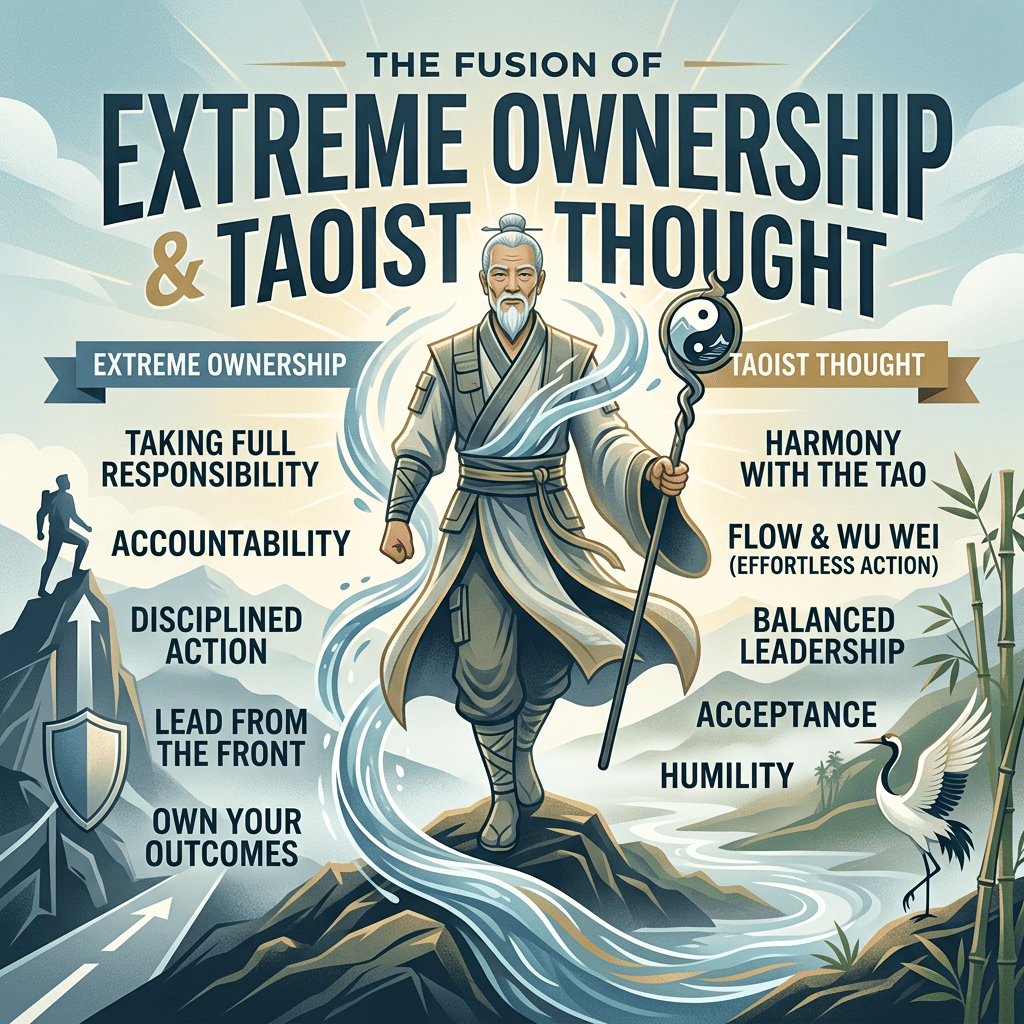
In the chaos of combat, business, or everyday life, two seemingly opposite philosophies offer a surprising path to mastery: Jocko Willink’s Extreme Ownership and ancient Taoist thought. Jocko’s no-excuses, take-charge leadership style—forged in the fire of Navy SEAL operations—feels worlds apart from the flowing, effortless wisdom of Lao Tzu. Yet both traditions point toward the same goal: becoming the kind of person who owns their reality and moves through it with power and peace. This post defines the core ideas of each, compares and contrasts them, and explores how they can work together for modern leaders, parents, entrepreneurs, and anyone seeking to level up.
What Is Extreme Ownership?
Extreme Ownership is the foundational leadership philosophy from Jocko Willink and Leif Babin’s bestselling book Extreme Ownership: How U.S. Navy SEALs Lead and Win (2015). At its heart, it means taking 100% responsibility for everything in your world—your team’s performance, your mission’s success or failure, and every outcome—without blame, excuses, or finger-pointing. Leaders who practice it refuse to play the victim; instead, they own the problem and fix it.
Key principles (with short definitions):
- Extreme Ownership: The leader accepts complete accountability for all results—good or bad. No exceptions.
- No Bad Teams, Only Bad Leaders: Poor performance is never the team’s fault alone; it reflects the leader’s failure to train, communicate, or lead effectively.
- Check Your Ego: Suppress self-importance and pride so decisions serve the mission and the team, not the leader’s image.
- Believe: Fully commit to the mission and sell it convincingly to your team so everyone buys in.
- Cover and Move: The fundamental tactic of moving forward while protecting the team—advance while someone covers you.
- Simple: Keep plans, orders, and communication crystal-clear; complexity kills execution.
- Prioritize and Execute: In chaos, identify the highest-priority task, focus on it relentlessly, then move to the next.
- Decentralized Command: Empower junior leaders to make decisions within clear boundaries so the team can act fast without waiting for top-down approval.
- Discipline Equals Freedom: Strict daily discipline creates the freedom to perform at the highest level and live life on your own terms. (Jocko’s famous line: “Discipline equals freedom.”)
What Is Taoist Thought?
Taoist thought (Taoism) is an ancient Chinese philosophy and way of life rooted in the Tao Te Ching (The Book of the Way and Its Virtue), traditionally attributed to Lao Tzu around the 6th century BCE. It teaches living in harmony with the Tao—the natural, ineffable order of the universe—rather than forcing outcomes through willpower alone. The goal is effortless alignment, balance, and natural flow instead of struggle.
Key principles (with short definitions):
- Tao (The Way): The fundamental, nameless principle that underlies and flows through all existence. It cannot be fully described; one must align with it.
- Wu Wei (Effortless Action / Non-Forcing): Acting without strained effort—doing only what is natural and necessary so results arise spontaneously, like water flowing downhill.
- Humility (Valley Spirit / Low Position): The wise person stays humble, yielding, and unassuming, like a valley that receives all waters or water that seeks the lowest place yet overcomes the hardest rock.
- Simplicity (Pu – The Uncarved Block): Returning to a natural, unadorned state free from artificial complexity, desires, and over-thinking.
- Yin and Yang: The dynamic balance of complementary opposites (passive/active, dark/light, yielding/assertive) that together create wholeness; nothing is purely one or the other.
- Ziran (Naturalness / Self-So): Allowing things to be as they naturally are; spontaneity and authenticity without artificial interference.
A classic Taoist leadership ideal from the Tao Te Ching: “A leader is best when people barely know he exists… When his work is done, his aim fulfilled, they will say: ‘We did it ourselves.’”
Comparison: Where Extreme Ownership and Taoism Overlap
At first glance they look like opposites, but the philosophies converge in powerful ways:
- Humility and Ego Control: Jocko’s “Check Your Ego” mirrors Taoist humility. Both demand that leaders set aside pride so the mission (or the Tao) can flow.
- Simplicity: Extreme Ownership’s “Keep it Simple” echoes Taoist Pu—cut through unnecessary complexity so clarity and natural action emerge.
- Personal Responsibility and Self-Mastery: Extreme Ownership insists you own everything in your world. Taoism insists you align with the way things actually are. Both reject victimhood and demand radical self-accountability.
- Discipline Leads to Freedom: Jocko’s mantra “Discipline equals freedom” finds a Taoist cousin in the freedom that comes from living in effortless harmony with the Tao—you train so rigorously that right action becomes natural.
Both traditions produce calm, effective leaders who get results without drama.
Contrast: Control vs. Flow
The real tension—and the richest learning—lies in their differences:
- Proactive Control vs. Effortless Flow: Extreme Ownership is aggressive and directive. Leaders plan, seize initiative, and take ownership of outcomes in chaotic environments. Taoism leans into wu wei—relinquish forced control, trust the natural order, and act only when the moment is ripe. Over-control, in Taoism, creates resistance.
- Military Precision vs. Natural Spontaneity: SEAL tactics (Cover and Move, Prioritize and Execute) emphasize structure and decisive action. Taoist thought values ziran—letting situations unfold organically and responding fluidly.
- Top-Down Accountability vs. Invisible Leadership: Jocko places total responsibility on the leader at every level. Lao Tzu’s ideal leader is so subtle that people feel they succeeded on their own.
In short, Extreme Ownership is yang—active, assertive, shaping reality—while Taoism is yin—receptive, yielding, harmonizing with reality.
Synthesis: The Best of Both Worlds
The magic happens when you combine them. Practice Extreme Ownership to own your reality fully—no excuses, total accountability. Then apply Taoist wisdom to move through that reality with minimal wasted effort.
Practical integration ideas:
- Own the mission completely (Extreme Ownership), then lead with wu wei so your team feels they did it themselves (Taoist leadership).
- Use “Prioritize and Execute” to cut through chaos, then trust ziran—once priorities are clear, let the team flow naturally.
- Build iron discipline every morning (Jocko-style), so you can respond with effortless humility and simplicity when the unexpected hits (Taoist flow).
- Check your ego ruthlessly, stay humble like water, and watch how much farther you travel with less resistance.
In today’s hyper-competitive, distraction-filled world, this blend creates leaders who are simultaneously disciplined and adaptable, accountable and harmonious, decisive and at peace.
Final Thought
Jocko Willink and Lao Tzu may have lived centuries and cultures apart, yet both understood a timeless truth: real power begins with radical self-responsibility and ends in effortless mastery. Extreme Ownership gives you the spine; Taoist thought gives you the flow. Embrace both, and you won’t just lead—you’ll move through life like water that owns every wave it rides.
What principle from either tradition resonates with you most right now? Drop it in the comments—I’d love to hear how you’re blending discipline and flow in your own life.
Stay hard. Stay humble. Flow on.


Leave a Reply